Abstract
In Japan, initiatives to promote a society in which people with dementia and the general public live together are being implemented. As part of these initiatives, people with dementia engage in information dissemination based on their own experiences and participate in peer support activities. Since 2018, we have implemented multigenerational exchange activities with people with dementia in public libraries in Fukuoka Prefecture. As a specific approach, we introduced a “Dementia Book Café,” with the cooperation of citizen volunteers and high school and university student volunteers. In 2025, eight Dementia Book Café sessions were conducted at three public libraries. Questionnaires were administered to participating citizens, citizen volunteers, and student volunteers. We found no significant difference in the number of citizens and volunteers who reported that the activities were “enjoyable” (p = 0.81), indicating that the program was mutually satisfying. Multigenerational interactions that included people with dementia promoted human resource development and facilitated participation in various shared activities. These processes may contribute to initiatives aimed at promoting an inclusive society.
Keywords
Dementia Intergenerational Exchange Public Library Inclusive Society
1. Introduction
In Japan, the Basic Act on Dementia for the Promotion of a Coexistent Society was enacted in 2024. Since then, various initiatives have been implemented to promote a society in which people with dementia and the general public live together. As part of these initiatives, people with dementia disseminate information based on their experiences and participate in peer support activities.
Since 2018, we have conducted multigenerational exchange activities with people with dementia (hereafter referred to as “the activities”) at a public library in Fukuoka Prefecture. The activities consist of three core components: (1) establishing a special booth displaying books related to dementia, (2) conducting a Dementia Book Café, and (3) organizing educational lectures introducing books on dementia. Citizen volunteers and high school and university student volunteers are involved in components (1) and (2).
The term “Dementia Book Café” was coined by our group. It refers to gatherings held within libraries where people with dementia, their caregiving family members, and community residents interact through conversation and reading activities.
As of February 2026, four public libraries have adopted this program, indicating increasing institutional support. However, it is necessary to evaluate the suitability of these three approaches for wider dissemination in public libraries. In 2025, we conducted a questionnaire survey among citizens, citizen volunteers, and student volunteers who participated in the Dementia Book Café. This study reports the effectiveness of these approaches based on the survey results.
2. Ethical Considerations
Approval for this study was obtained from all relevant stakeholders and volunteers. The purpose of the survey was explained to participants both verbally and in writing, and they were informed that personal identification would be protected. Consent was considered obtained when participants completed the questionnaire and checked a consent checkbox.
3. Activity Introduction
(1) Activity Goals
The year of introduction differed among the public libraries. Each library implemented the program in stages (Table 1). For example, libraries introduced Goal 1 in the first year and advanced to Goal 2 in the following year.
Goal 1: “Creating opportunities for people with dementia and their caregiving families to access books,” was achieved through displaying dementia-related books, attaching explanatory notes, and organizing lectures.Goal 2: “Promoting accurate understanding of dementia among multigenerational citizens,” was achieved by using Dementia Book Cafés as hosting venues and encouraging mutual understanding through interaction.Goal 3: The Dementia Book Café was positioned as a venue for social participation, where people with dementia and their families could share their experiences and teach younger generations about local history.
| Goal | Description | Implementation |
| 1 | Creating opportunities to access books | Book displaysExplanatory notes |
| 2 | Promoting accurate understanding | Public lecturesDementia Book Café |
| 3 | Providing opportunities for interaction and social participation | Dementia Book Café |
(2) Implementation of Activities
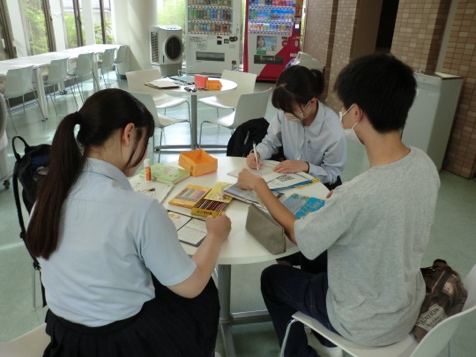
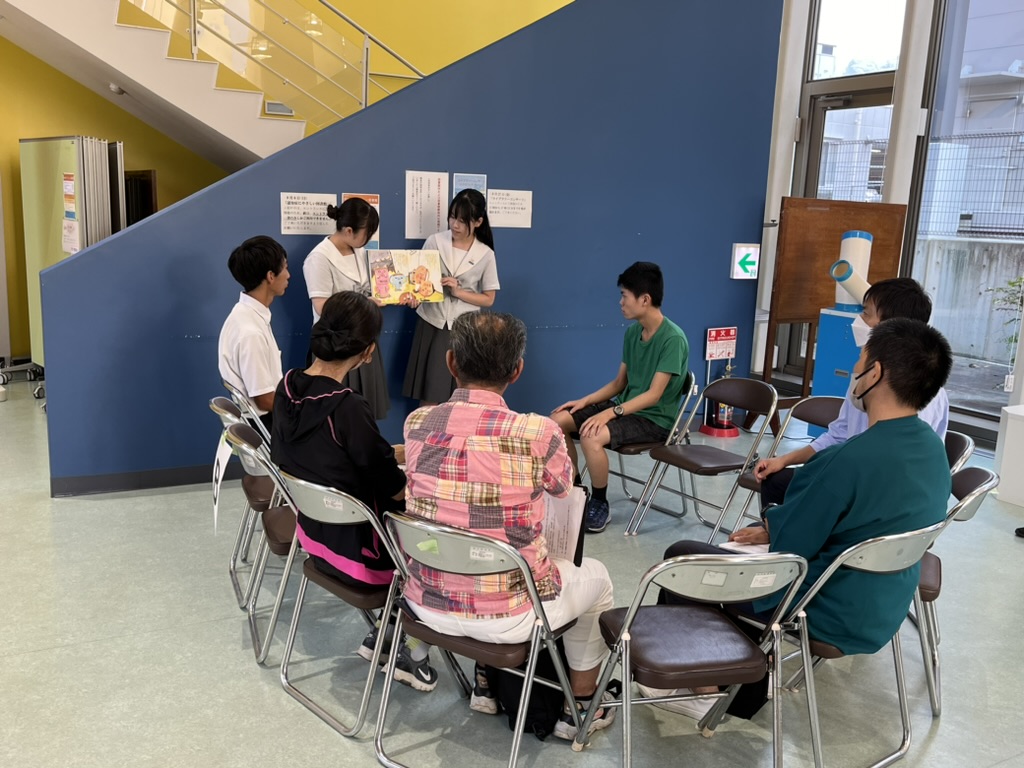
In 2025, six sessions were conducted at three public libraries, all of which implemented the Dementia Book Café. Books for display were selected by student volunteers, who also prepared and attached explanatory notes (Figure 1). During the cafés, student volunteers conducted picture-book readings (Figure 2). In addition, older adults, including people with dementia, and student volunteers created origami cranes together. As the folding process was challenging, student volunteers learned the technique from the older participants, promoting reciprocal interaction.
4. Materials and Methods
A questionnaire survey was conducted. The participants were 62 citizens and 28 volunteers (10 citizen volunteers, 18 student volunteers). The survey was administered on October 8 and October 16, 2025.
Citizen volunteers were required to complete dementia-related training prior to participation. Student volunteers were enrolled in nearby high schools and universities.
The questionnaire included two common items for the citizens and the volunteers:(1) open-ended comments on impressions and opinions regarding participation, and(2) willingness to cooperate in future activities (“able to cooperate” or “unable to cooperate”). Participants who answered “able to cooperate” were asked to specify possible forms of contribution.
Data were analyzed using SPSS version 30 (IBM Corp.). Significance was set at p < 0.05.
5. Results
Valid responses were obtained from 58 citizens (response rate: 93.5%), with a mean age of 62.3 ± 10.2 years. In the open-ended responses, 22 participants (37.9%) reported that the activities were “enjoyable.” Detailed comments included: “It is reassuring that local university students participated” (4 responses, 6.9%), “This is a new initiative and I look forward to its development” (1 response), “I appreciated the intellectual atmosphere” (1 response, 1.7%), “It has been a long time since I interacted with young people” (1 response, 1.7%), “I felt encouraged by the picture-book reading” (1 response, 1.7%), and “I would like to invite neighbors with dementia” (1 response, 1.7%).
Regarding willingness to cooperate, 56 citizens responded that they were “able to cooperate.” Among them, 17 (30.4%) stated that they could participate as conversation partners, and 21 (37.5%) preferred to begin after receiving dementia-related training. On the other hand, two respondents (3.4%) answered that they were “unable to cooperate.”
Twenty-four volunteers responded (response rate: 85.7%), with a mean age of 26.4 ± 2.4 years. Nine volunteers (37.5%) stated that the activity was “enjoyable,” explaining that it was more enjoyable than other dementia cafés (2 responses, 8.3%), that people with dementia were no different from others (5 responses, 20.8%), and that books functioned as the main topics of conversation (2 responses, 8.3%). Ten volunteers (41.7%) described the experience as “valuable,” highlighting first-time conversations with people with dementia (5 responses, 20.8%) and experiences communicating with them (3 responses, 12.5%); however, two volunteers (8.3%) experienced challenges in communicating effectively. Regarding future participation, 22 volunteers responded that they were “able to cooperate,” including those willing to contribute as conversation partners (10 responses, 41.7%) and through reading activities (8 responses, 33.3%), whereas two volunteers (8.3%) answered that they were “unable to cooperate.”
No significant difference was found between citizens and volunteers in the proportion reporting that the activity was “enjoyable” (p = 0.81). Willingness to participate as volunteers was similarly high in both groups (p = 0.73).
6. Discussion
Multigenerational exchange programs in public libraries are important, as libraries are easily accessible public facilities for citizens, including people with dementia. Familiar environments, such as libraries, may serve as strong motivators for participation and help alleviate anxiety related to social interaction, thereby encouraging broader participation.
Survey responses suggested that people with dementia actively participated. Thus, increasing their participation may further promote peer support. Moreover, public libraries may help address the “blank period”1) following diagnosis, during which individuals lack support and guidance. The participation of volunteers without prior experience communicating with people with dementia suggests that these activities contribute to the development of human resources.
These activities are sustained through extensive collaboration involving shared goals, planning, and role allocation. Preparations typically begin more than a year in advance. A previous study of collaborating library staff reported improved understanding of dementia and enhanced counter services2). Such preparatory and implementation processes contribute to capacity building and ultimately improve library accessibility and comfort for people with dementia.
Previous dementia-related educational programs mainly focused on people with dementia and their families. However, initiatives aiming to develop a more coexistent society will expand opportunities for citizens and volunteers to learn from people with dementia. Public libraries satisfy intellectual curiosity and provide emotional fulfillment through interaction. Active involvement of volunteers is essential for disseminating an intellectual and welcoming atmosphere more widely.
7. Conclusions
Multigenerational interactions involving people with dementia and mutual learning processes contribute to the development of human resources for a coexistent society. The effective use of public libraries and the wider dissemination of Dementia Book Cafés within these facilities may play an important role in promoting this type of society.
References
- Fujita K, Nagata K. What we wanted to convey by the term “blank period”: our initiatives. J Dement Care Case Stud. 2023;16:180-187. DOI: 10.4324/9780203051047-23
- Suzuki H. Collaboration between Hiroshima City Central Library and a medical university: toward a library friendly to everyone. Toshokan Zasshi. 2022;116:431-433. DOI: 10.7142/igakutoshokan.44.433